Updated Thu / 2026-10-15 / 1:50 PM CT
State SandboxOverview

The overview

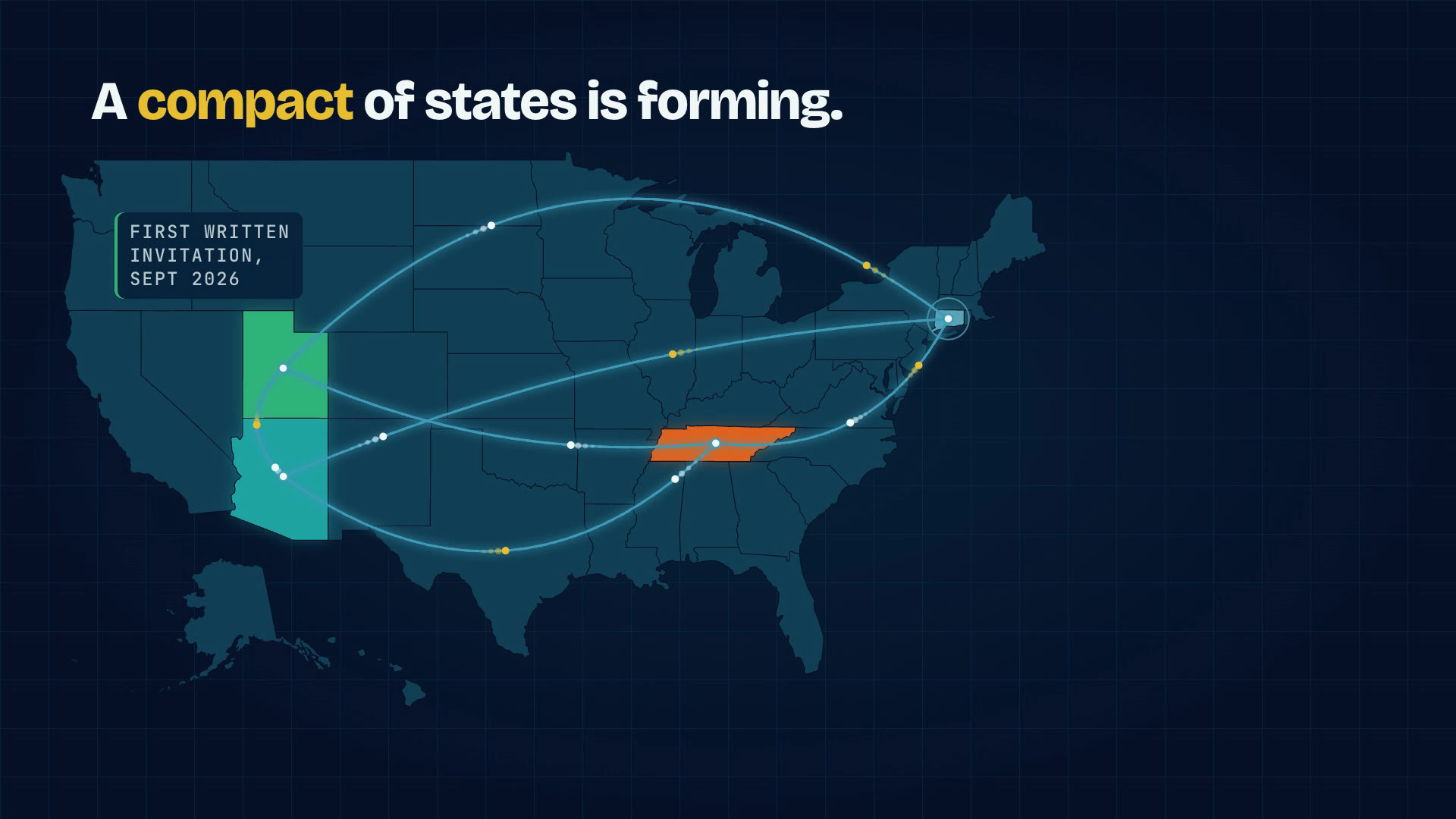
A compact of states is forming. Tennessee can join it.

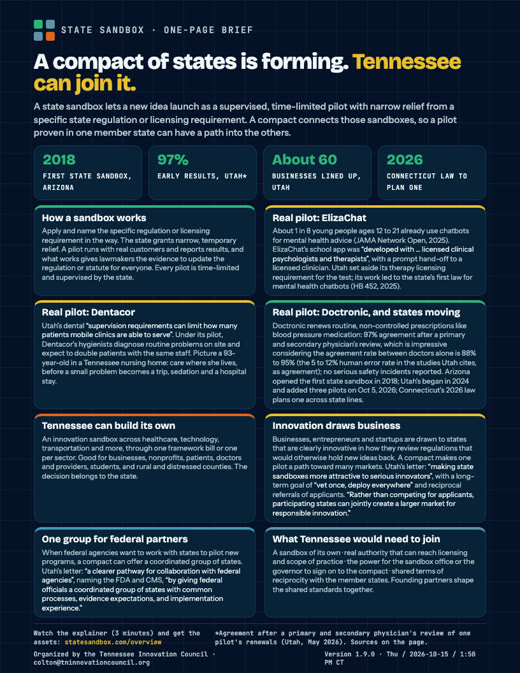
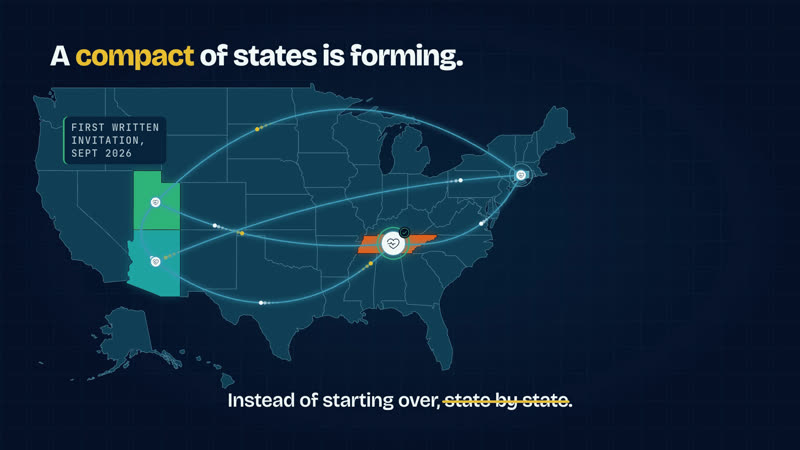
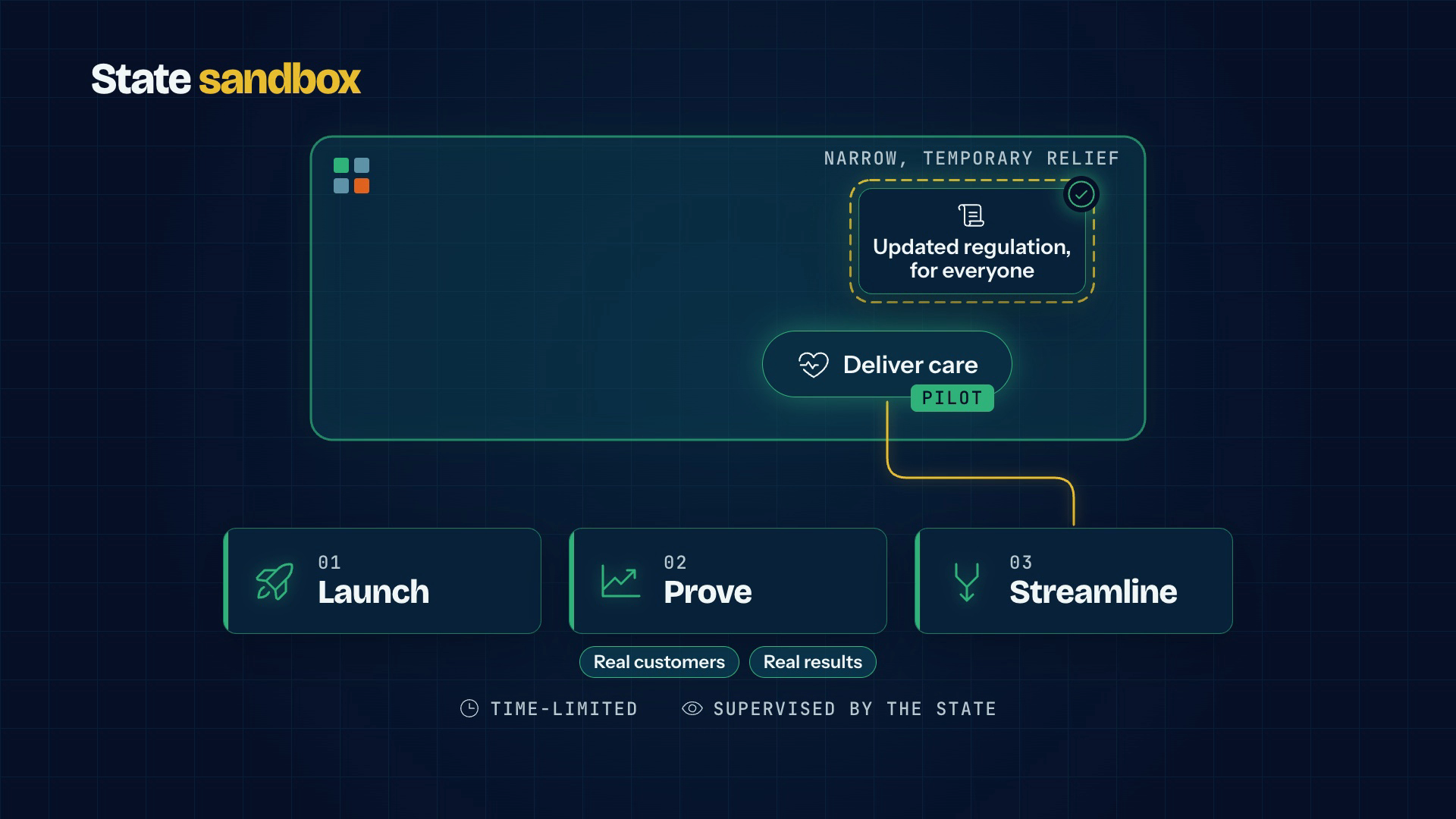
A state sandbox lets a new idea launch as a supervised pilot, with narrow, temporary relief from a specific state regulation or licensing requirement, while the state measures the results. A compact connects those sandboxes, so a pilot proven in one member state can have a path into the others.

  • 5 minutes to read
  • 3-minute video
  • Free to share

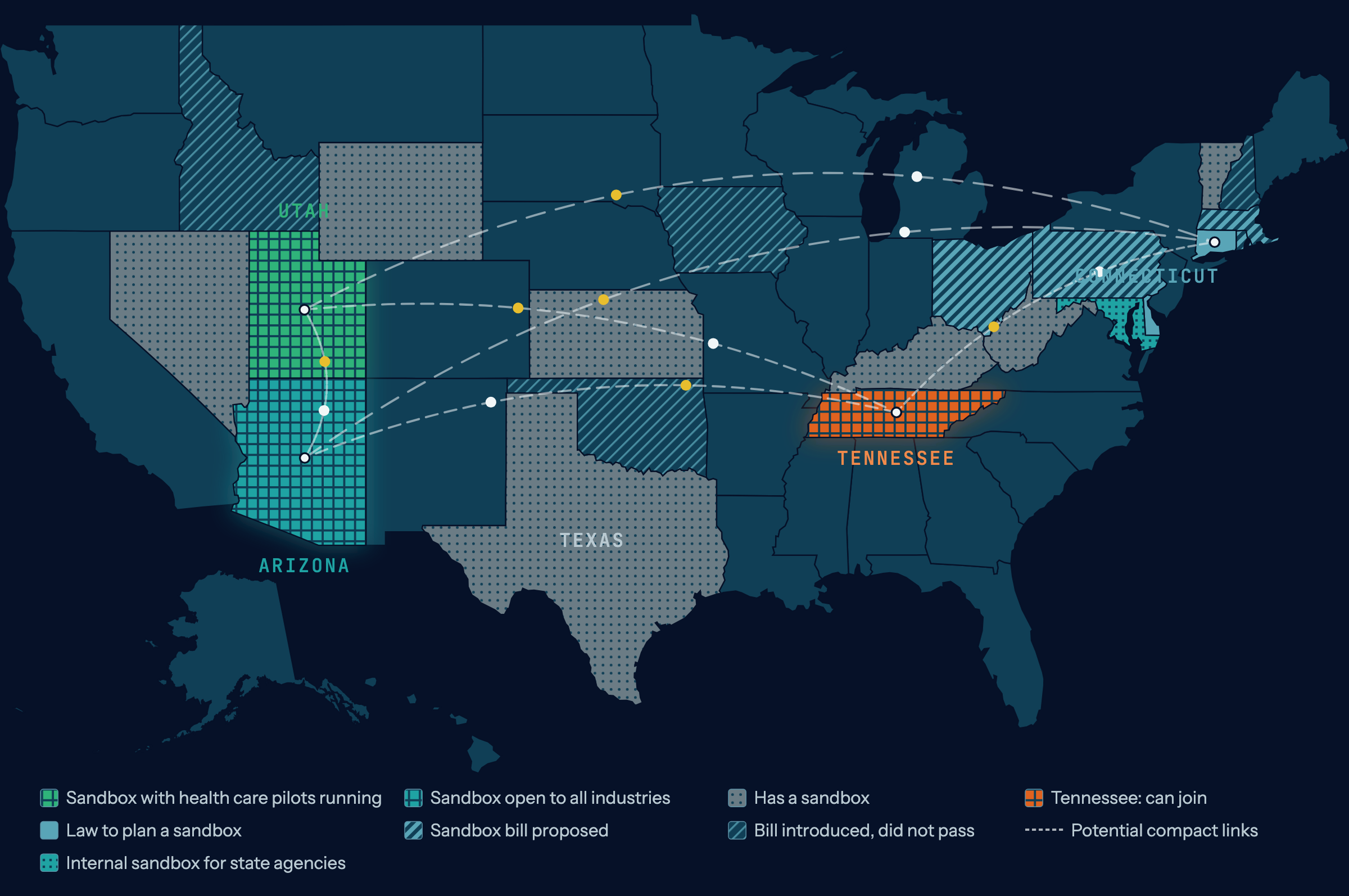
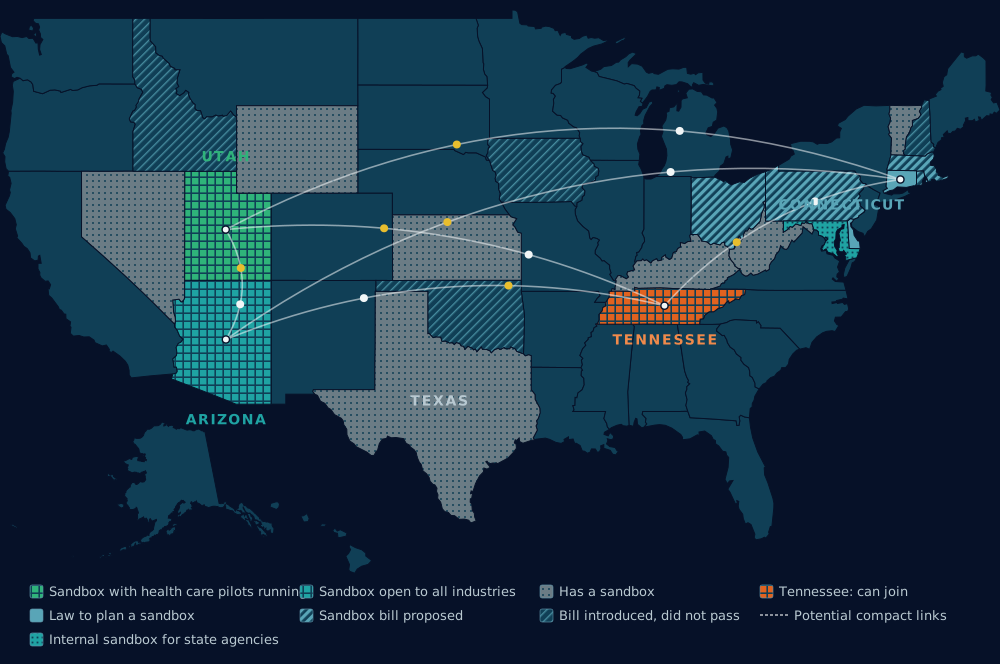
Point at a state. Twenty states have a sandbox, a law to plan one, or a bill, and any state that builds one can join a compact.

  • Sandbox with health care pilots running
  • Sandbox open to all industries
  • Has a sandbox
  • Law to plan a sandbox
  • Sandbox bill proposed
  • Bill introduced, did not pass
  • Internal sandbox for state agencies
  • Tennessee: can build its own and join
  • Potential compact links

From public records, including the Federation of State Medical Boards' sandbox chart (August 2026). Point at a state for its law.

The explainer

The whole idea in three minutes.

What a sandbox is, three real pilots and their results, why innovation draws business, the states already moving, why Tennessee can build its own, and how a compact connects the states that do. Show it in a meeting, send it ahead of one, or drop it in a deck.

Download the video (MP4, 14.4 MB) The script

1920 by 1080, narrated, 3 minutes.

01 · The idea

A faster path for new ideas.

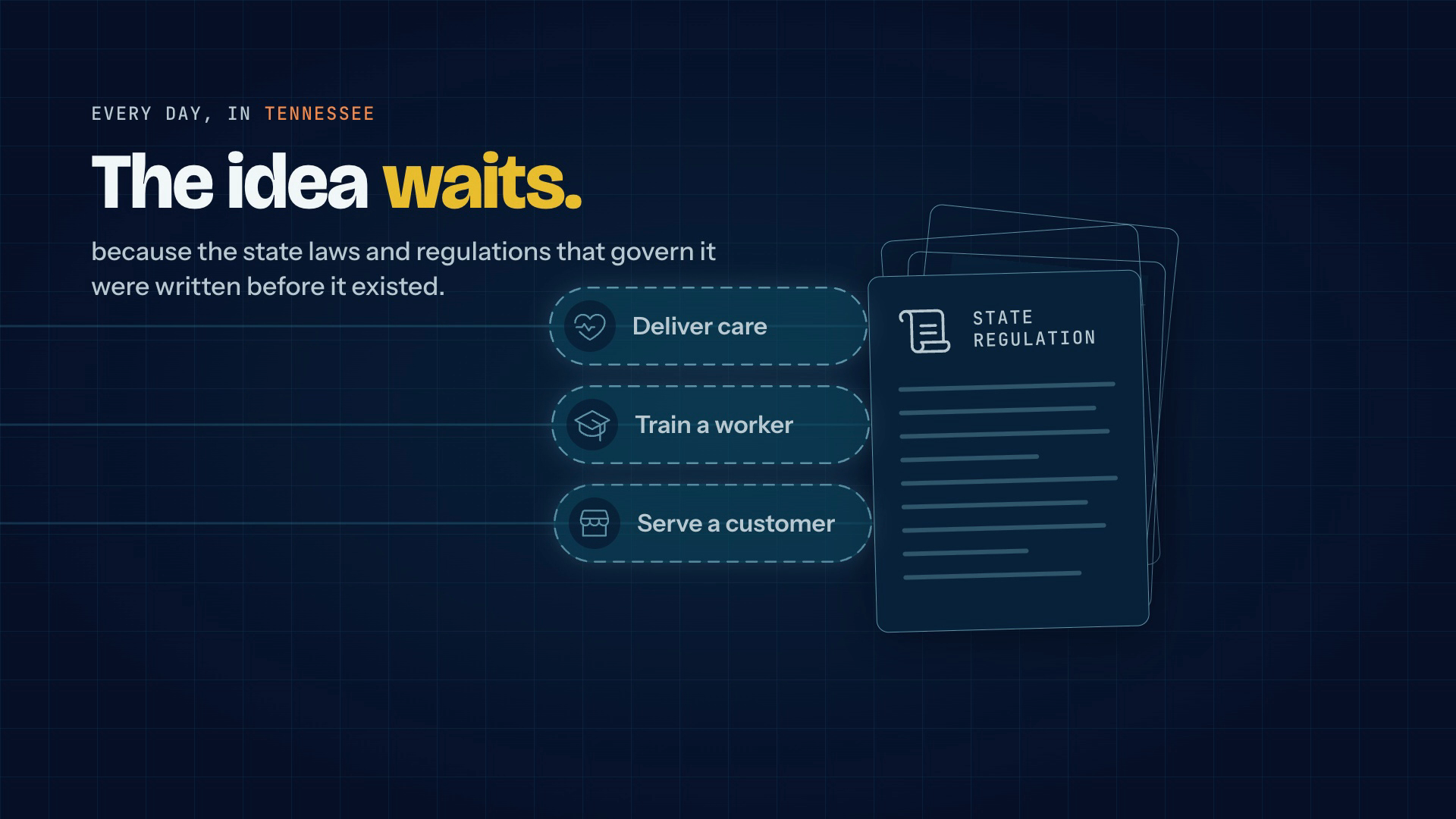
New ways to deliver care, train workers and serve customers often wait on state laws and regulations written before those ideas existed. A sandbox gives them a clear way to prove themselves, and gives lawmakers real evidence to work from.

  1. 01

    Apply

    A company, health system, nonprofit or entrepreneur applies for a pilot and names the specific regulation or licensing requirement in its way.

  2. 02

    Narrow, temporary relief

    The state grants relief from that one requirement, for the pilot only, with terms set alongside the regulators.

  3. 03

    Pilot

    A time-limited pilot runs with real customers, patients and students, and reports its results.

  4. 04

    Evidence

    Lawmakers and regulators see hard evidence on what worked.

  5. 05

    An updated regulation

    What works gives lawmakers the evidence to update the regulation or statute for everyone.

Every pilot is time-limited and supervised by the state.

02 · What it looks like

Three real pilots anyone gets right away.

A sandbox is easiest to see in the people it reaches. Each started with a state regulation written for another time, and a real, supervised pilot that set it aside.

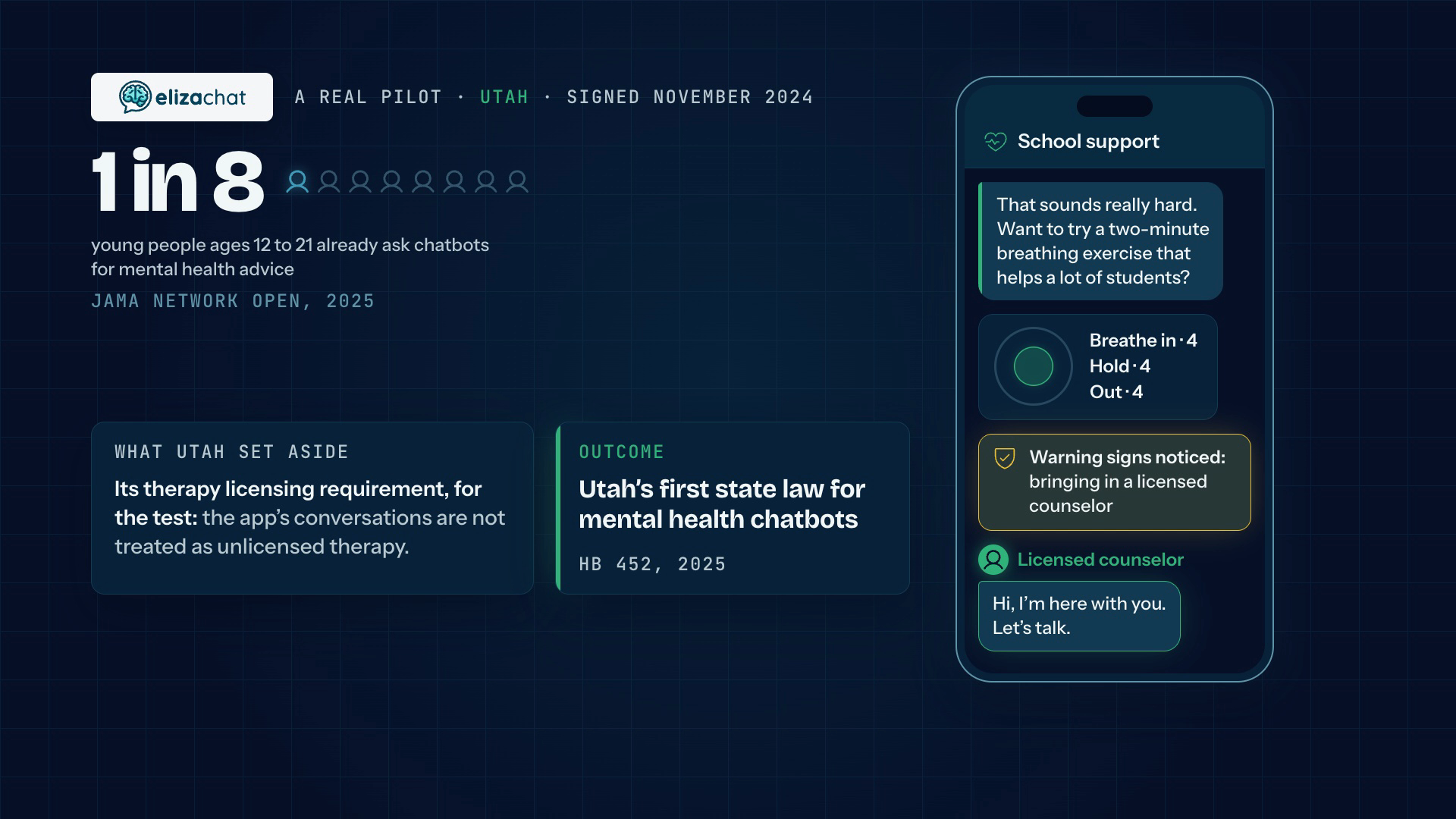
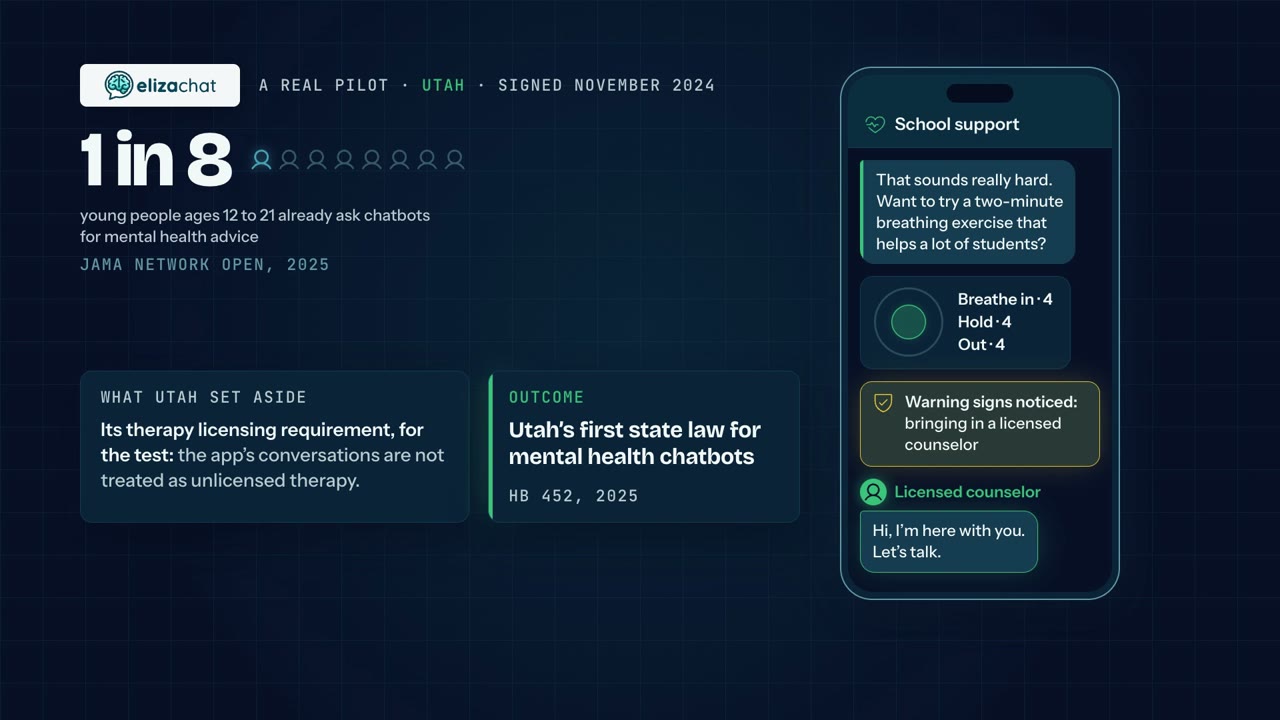
From the explainer: a school support app on a phone guides a stressed student through a breathing exercise, then brings in a licensed counselor.

A real pilot · mental health, for students

ElizaChat

A chatbot built for it

1 in 8young people ages 12 to 21 already use chatbots for mental health advice. JAMA Network Open, 2025
  • Utah's first pilot, ElizaChat, was “developed with our clinical advisory board, composed of trained and licensed clinical psychologists and therapists.”
  • Guided conversations and coping strategies, “built on evidence-based therapeutic principles.”
  • Users who show high-risk signs “shall also promptly be connected with a licensed psychologist or therapist for a real-time intervention.”
  • What Utah set aside: its therapy licensing requirement, for the test. The app's conversations are not treated as unlicensed therapy.
  • Outcome: Utah's work in this area led to the state's first law for mental health chatbots, House Bill 452 (2025).

Utah's pilot pageThe signed agreementIts clinical boardUtah, on the law
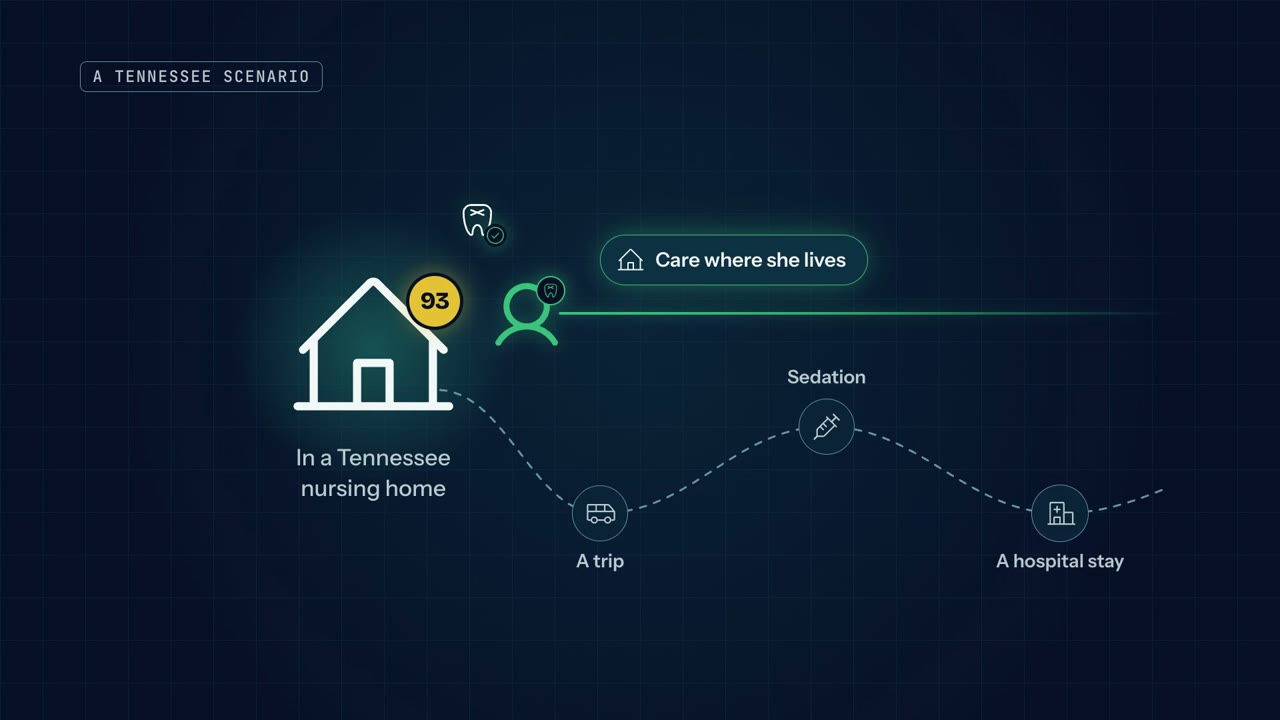
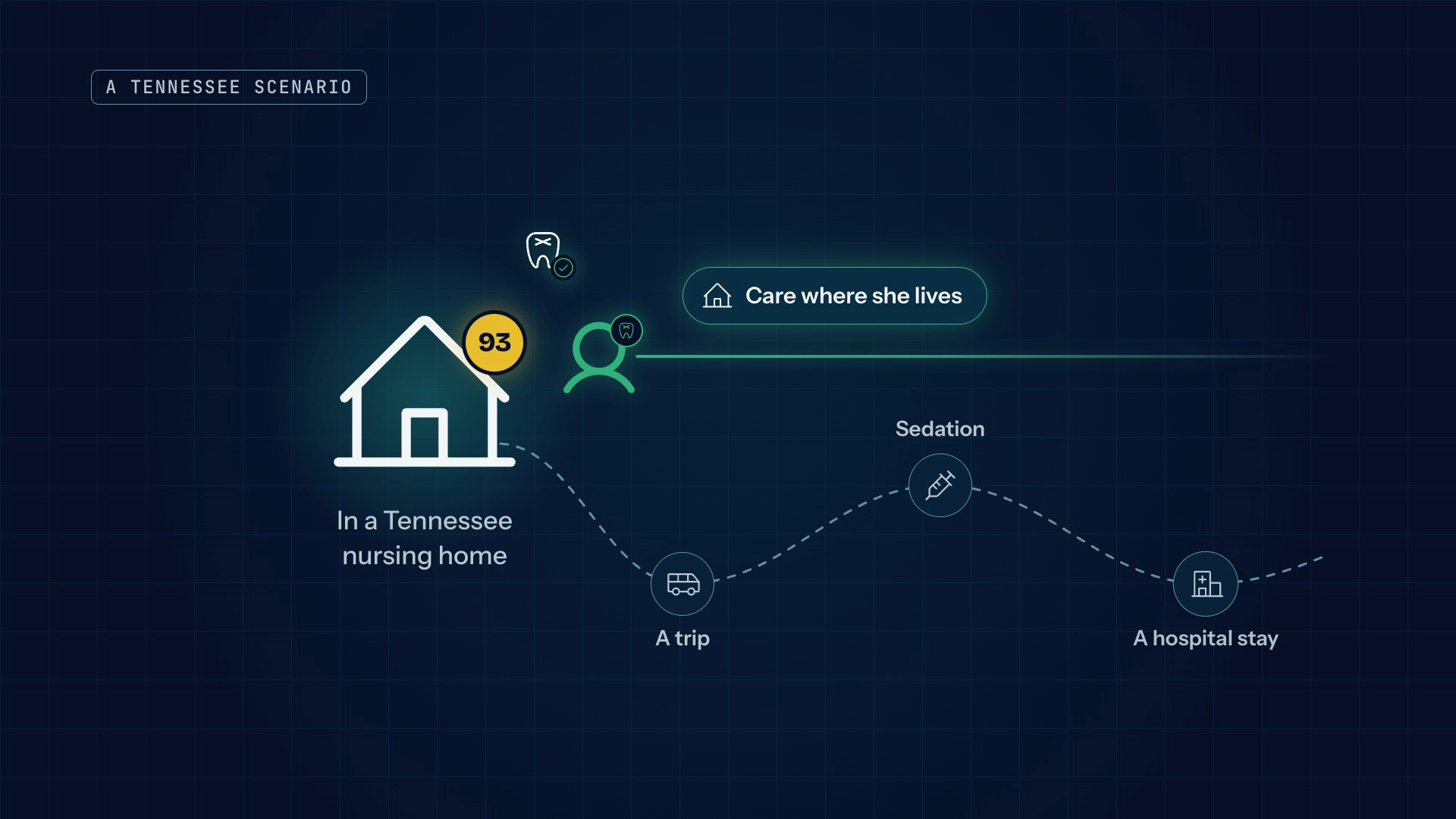
From the explainer: a nursing home with a 93-year-old resident; a hygienist comes to her, while the long route of a trip, sedation and a hospital stay is dimmed.

A second real pilot · dental care, where people are

Dentacor

Care where she lives

  • Utah found that its dental “existing supervision requirements can limit how many patients mobile clinics are able to serve.”
  • Under its pilot, Dentacor's licensed hygienists may diagnose a defined list of conditions on site, and the clinic expects “to at least double the amount of patients we are able to see without increasing staff.”

A Tennessee scenario

Picture a 93-year-old in a nursing home. Poor oral health among people in care facilities is linked to “cardiovascular and respiratory problems, including infective endocarditis and aspiration pneumonia.” Tennessee already lets hygienists work in nursing homes under a dentist's written protocol. A sandbox could test the next step Utah is testing: finding routine problems where she lives, before a small problem becomes a trip, sedation and a hospital stay.

Utah's pilot pageThe agreementNIH, Oral Health in AmericaTennessee Code 63-5-115

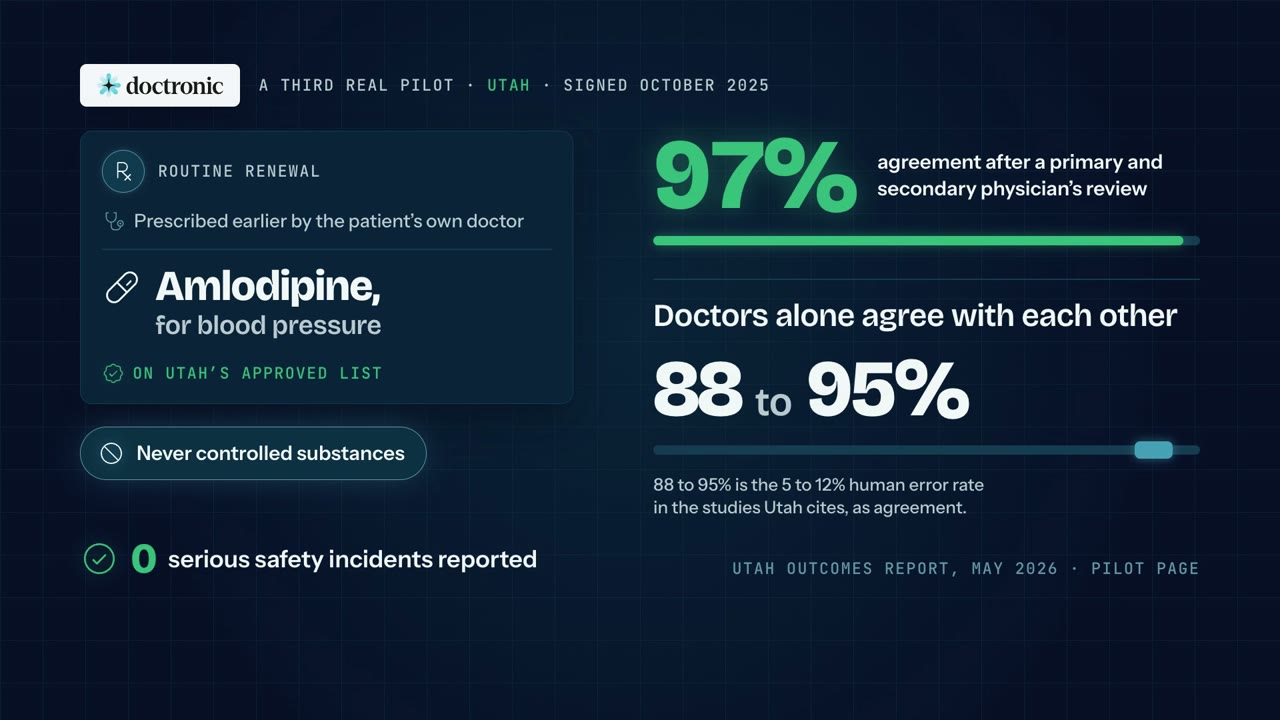
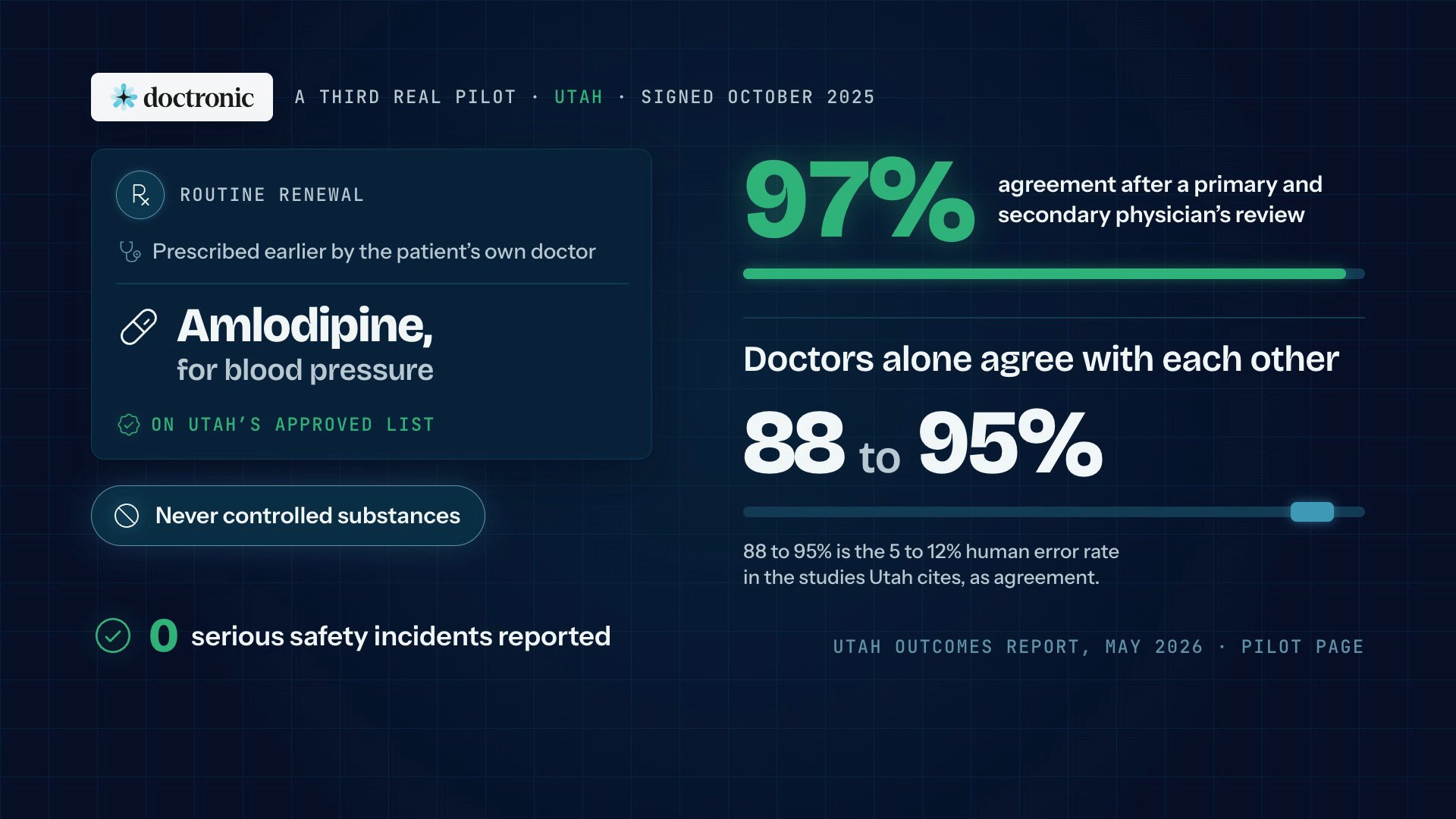
From the explainer: a routine, non-controlled renewal of amlodipine for blood pressure, with 97% agreement after a primary and secondary physician's review, beside the 88 to 95% agreement between doctors alone.

A third real pilot · routine prescriptions

Doctronic

Routine refills, safely

97%agreement after a primary and secondary physician's review, which is impressive considering the agreement rate between doctors alone is 88% to 95%. 88% to 95% is the 5 to 12% human error rate in the studies Utah's report cites, shown as agreement. Utah's report, May 2026
  • It renews routine prescriptions a doctor already wrote, like blood pressure medication: amlodipine is on Utah's approved list.
  • “The system explicitly excludes controlled substances from the renewal process.”
  • Utah's report notes “disagreement rates between human prescribers being described as moderate,” and that when a reviewing physician held a renewal back, “in most cases, the second physician disagreed with the first physician's concern.”
  • Safety: no serious safety incidents have been reported to Utah's office.

Outcomes reportThe signed agreementUtah's pilot page

03 · States moving

Utah went first. Other states are moving.

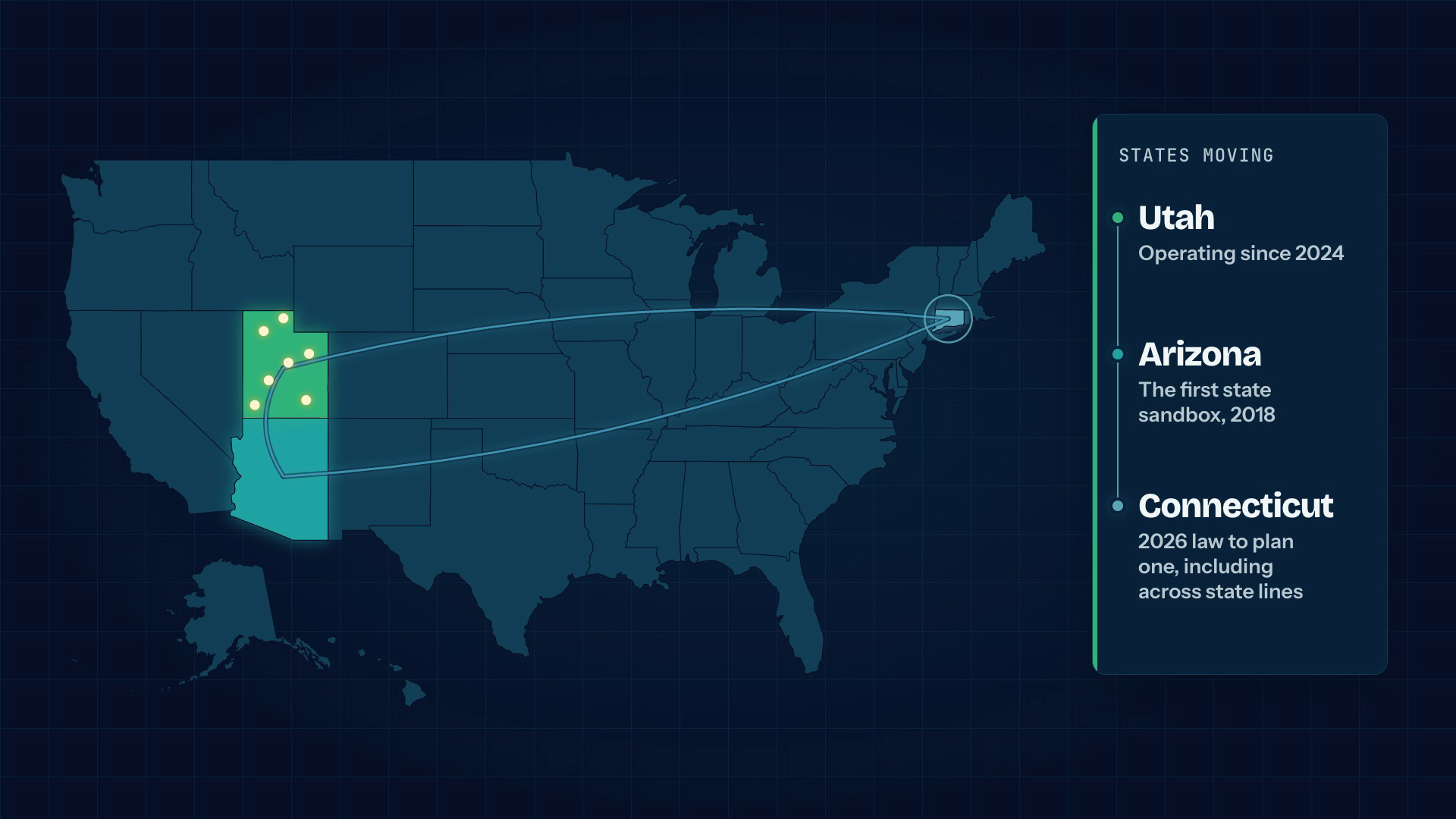
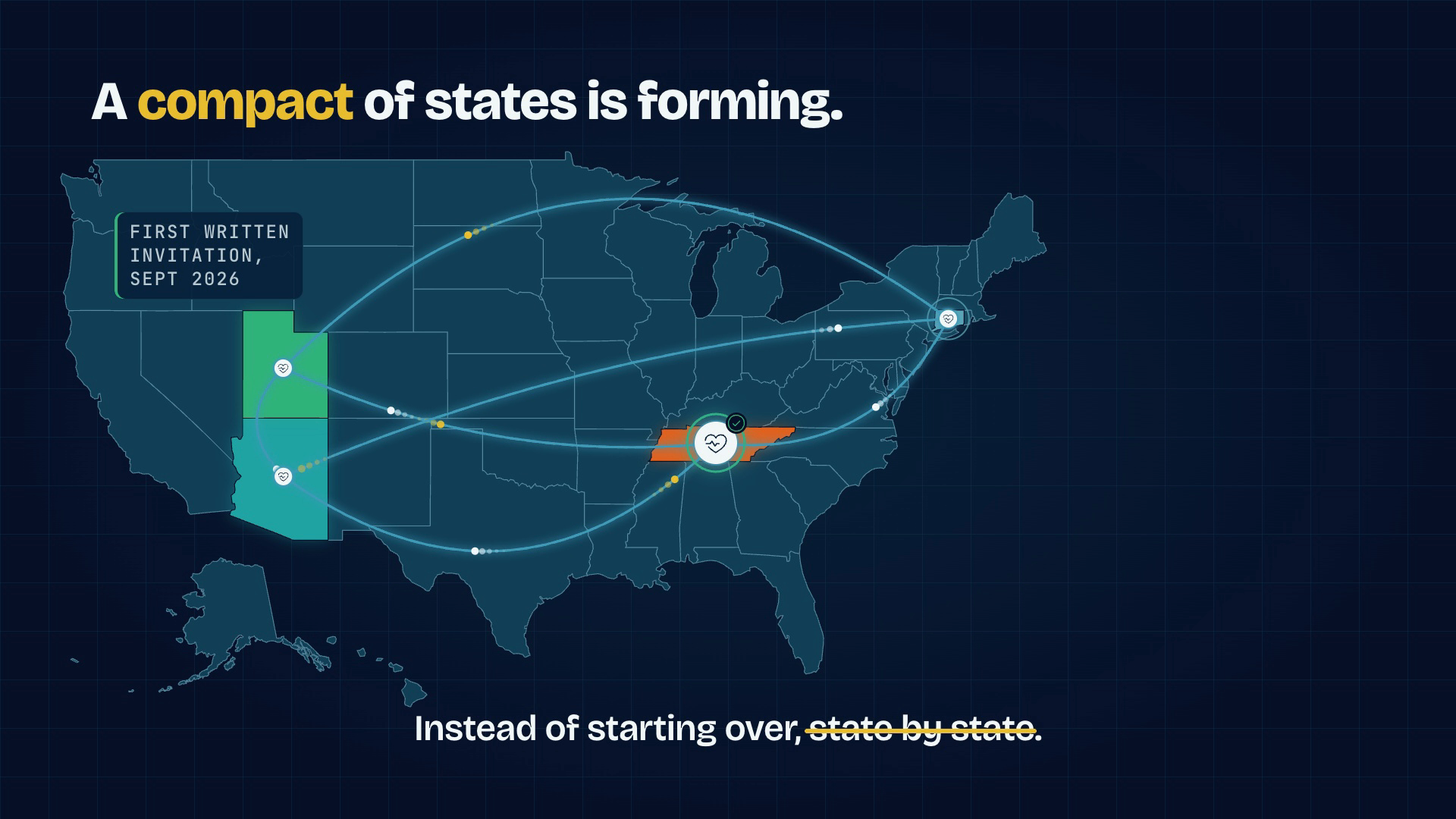
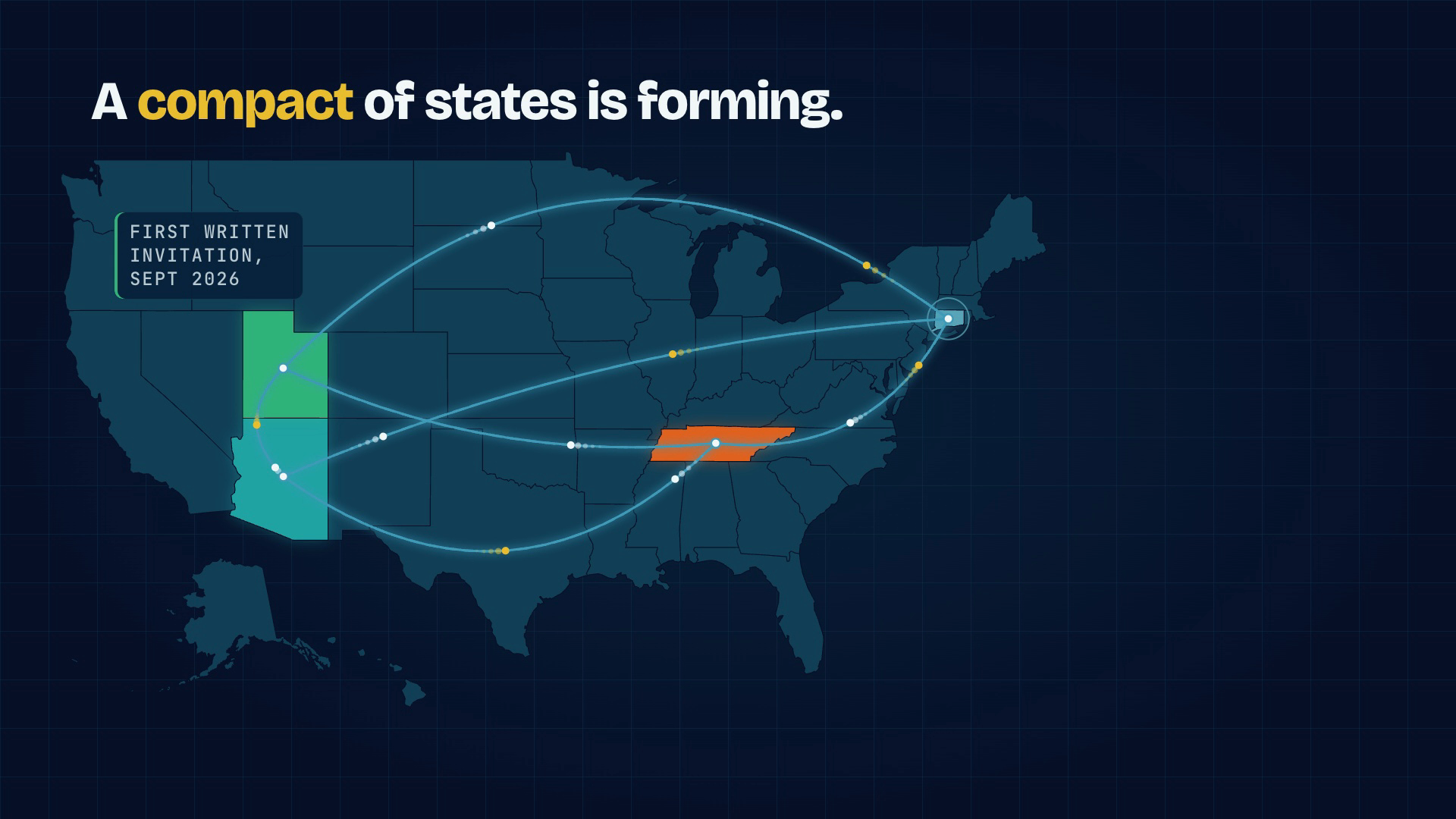
Arizona opened the first state sandbox in 2018. Utah's legislature created a broad one in 2024, and Connecticut passed a law this year to plan one, including how it could work across state lines. Nineteen states now have a sandbox, a law to plan one, or a bill. No state has to do this alone.

  • Arizona

    The first state sandbox, 2018; open to all industries since 2022.

    Arizona's 2022 law
  • Utah

    Operating since 2024, with seven approved pilots and the first written invitation to other states.

    Utah's 2024 law
  • Connecticut

    A 2026 law to plan a sandbox, including a reciprocal approach across state lines.

    Connecticut's 2026 act
  • Tennessee

    Can build its own innovation sandbox and join the states working together.

    What it would take

How Utah's sandbox got here

  1. 2024

    Created by law

    26 to 0 · 73 to 0

    A bipartisan, unanimous vote in the Senate and the House for Senate Bill 149.

    The bill
  2. Nov 2024

    First pilot signed

    1

    The school mental health app above, Utah's first agreement.

    Utah's release
  3. May 2026

    Early results

    97%

    Agreement after a primary and secondary physician's review of one pilot's renewals. No serious safety incidents reported.

    Utah's report
  4. 2026

    Business lined up

    About 60

    Businesses have applied to Utah's office or worked with it.

    Utah's letter
  5. Oct 5, 2026

    Built to scale

    5 agreements

    Three more pilots; master agreements with University of Utah Health and Intermountain Health; six independent evaluators who report to the office; tamper-evident records for the companies it selects.

    Evaluators and records
  6. Next

    Grow it with other states

    Every state

    Utah's public letter invites any interested state to work toward an interstate compact.

    Read the letter
“A sandbox can help an innovative company enter one state’s market. A network of interoperable sandboxes can create a practical pathway into many markets at once.”
Utah Office of Artificial Intelligence Policy, public letter of September 28, 2026

Utah's first four pilots · point at one, or tap it, to see the requirement it set aside

  • ElizaChat

    ElizaChat

    An app schools offer students: guided conversations, coping strategies, and a hand-off to a person when one is needed.

    Signed November 2024 · Utah's firstThe requirement set aside
    The requirement set aside

    Utah's licensing division agreed not to treat the app's conversations as unlicensed therapy during the test, in exchange for data sharing, a safety plan and a 30-day window to fix any problem.

    Utah's pilot page
  • Dentacor

    Dentacor

    Mobile dental hygiene for shelters, recovery programs and transitional housing: exams, X-rays, cleanings and dentures.

    Signed May 2025The requirement set aside
    The requirement set aside

    Its licensed hygienists may diagnose a defined list of conditions, with an X-ray reading tool concurring, instead of under a dentist's general supervision. Every case is reported monthly.

    Utah's pilot page
  • Doctronic

    Doctronic

    A telehealth clinic that renews routine, non-controlled prescriptions a doctor already wrote, like blood pressure medication, or hands the case to a doctor.

    Signed October 2025 · results publishedThe requirement set aside, and results
    The requirement set aside

    Its software may authorize renewals of verified prescriptions from a list of 192 drugs, in phases. In Phase 1 a physician reviews every renewal.

    97%agreement after a primary and secondary physician's review; doctors alone agree with each other 88% to 95% (the 5 to 12% human error rate in the studies Utah cites, as agreement)0serious safety incidents reported
    Utah's report, May 2026Safety record
  • Legion Health

    Legion Health

    An online psychiatry clinic testing refills of a short list of non-controlled maintenance medications.

    Signed March 2026The requirement set aside
    The requirement set aside

    Its software may authorize renewals of verified prescriptions on that list, behind a physician review gate: 98 percent agreement with physicians before each next phase.

    The agreement

Plus three approved in October 2026: acne care, prescription refills, and pelvic floor physical therapy. All of Utah's authorized pilots

Utah Senate Bill 149 and its votesUtah's approved pilotsUtah's letter (about 60 businesses)

04 · Tennessee

Tennessee can build its own.

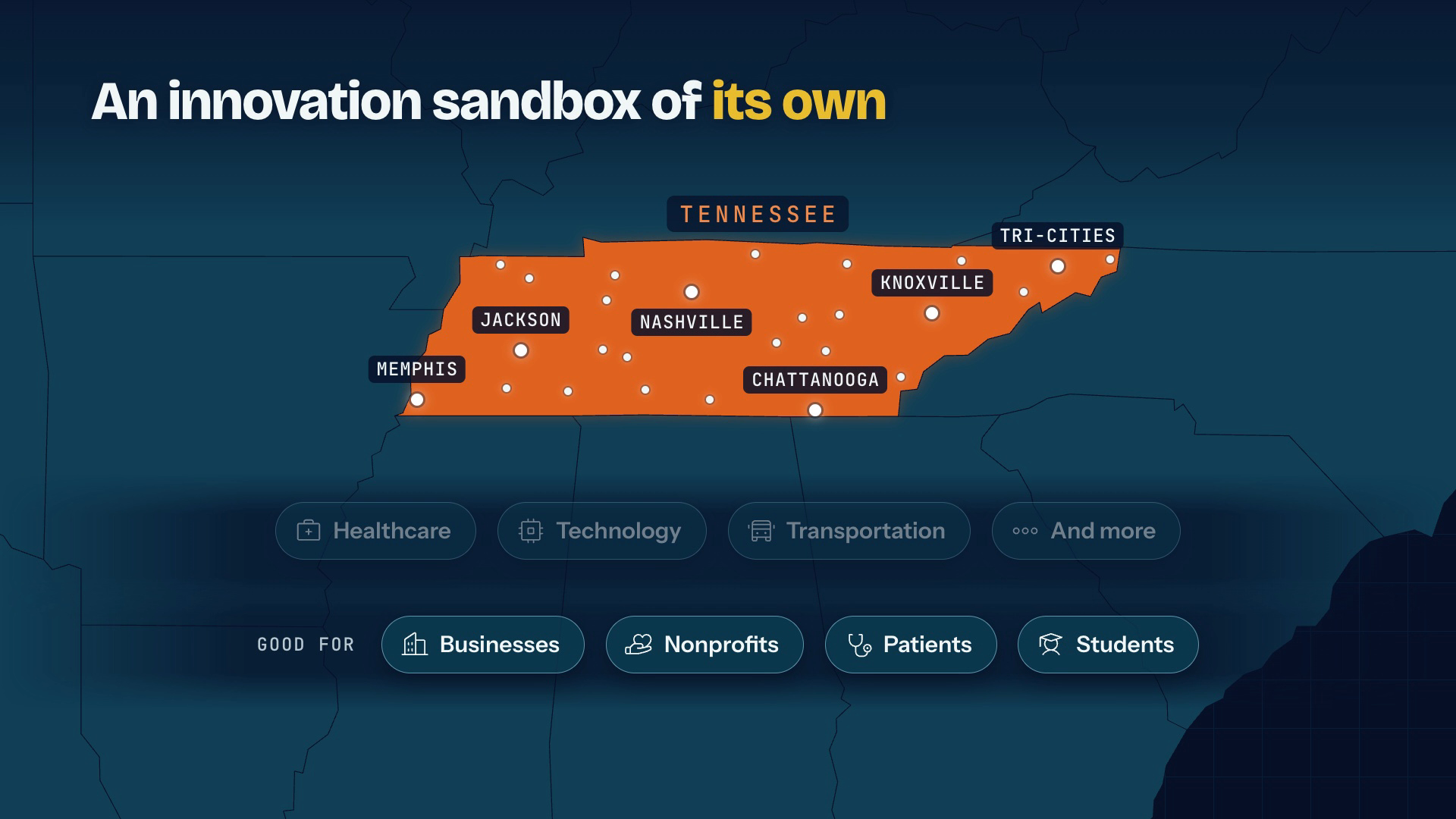
A Tennessee innovation sandbox could open lanes across healthcare, technology, transportation and more, through one framework bill or one bill per sector. The decision belongs to the state.

  • Healthcare
  • Technology
  • Transportation
  • And more
MemphisJacksonNashvilleChattanoogaKnoxvilleTri-Cities

From Memphis to the Tri-Cities, for cities and rural communities alike. Point at a city.

Good for

  • Businesses
  • Nonprofits
  • Patients
  • Doctors and providers
  • Students
  • Rural and distressed counties

05 · The compact

One pilot, a path into many states.

A compact of states is forming among those with an active innovation sandbox. Member states can share reviews, evidence and lessons, so a company that proves itself in one state does not start from scratch in the next. Each state keeps its own authority.

Without a compact

  1. TennesseeApplyReviewPilot
  2. Another stateApplyReviewPilotStarts over
  3. The next stateApplyReviewPilotStarts over

Inside a compact

  1. TennesseeApplyReviewPilot
  2. Shared evidence
  3. Another member stateExpedited reviewLaunch
  4. The next stateExpedited reviewLaunch

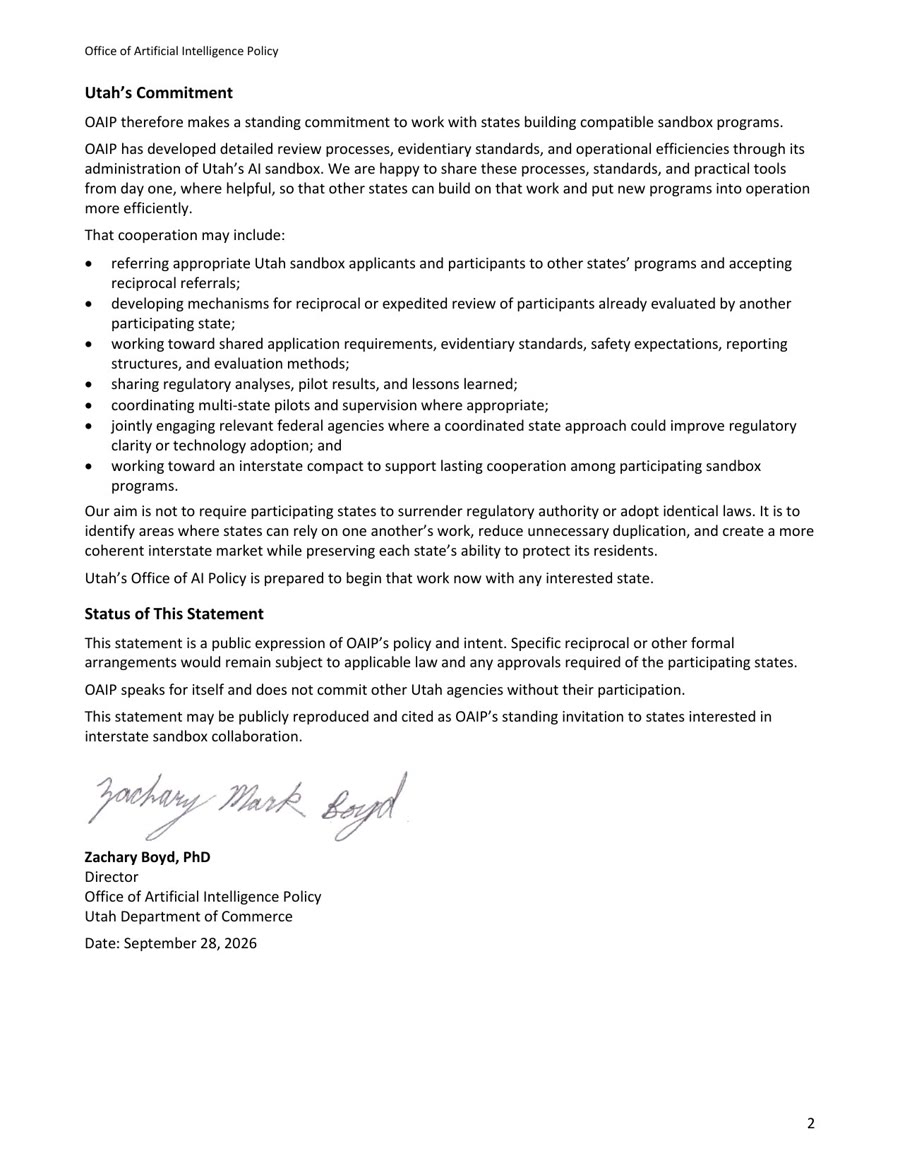
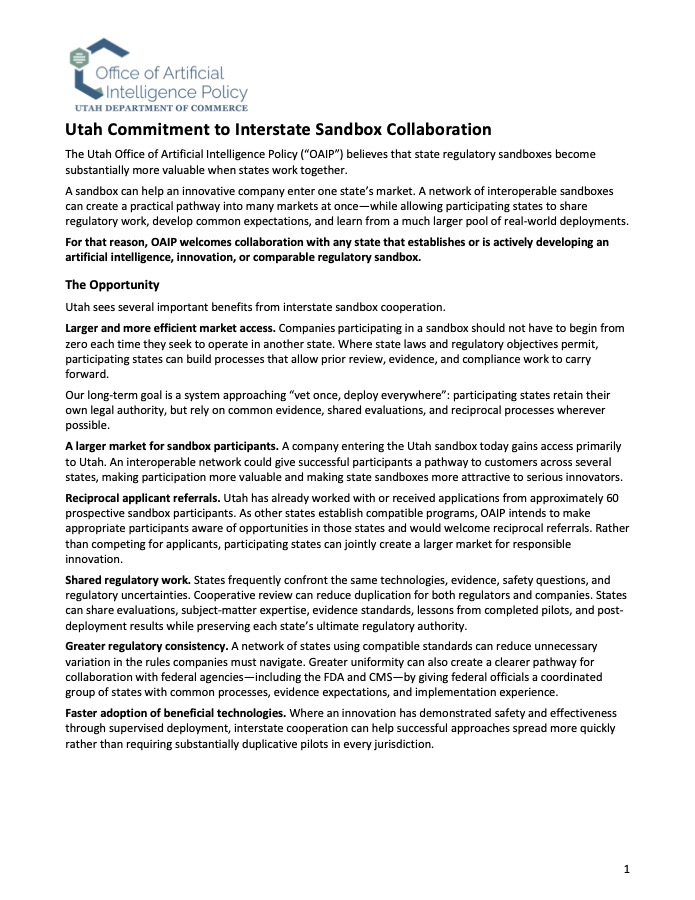
Utah's letter commits to “developing mechanisms for reciprocal or expedited review of participants already evaluated by another participating state.” Read it

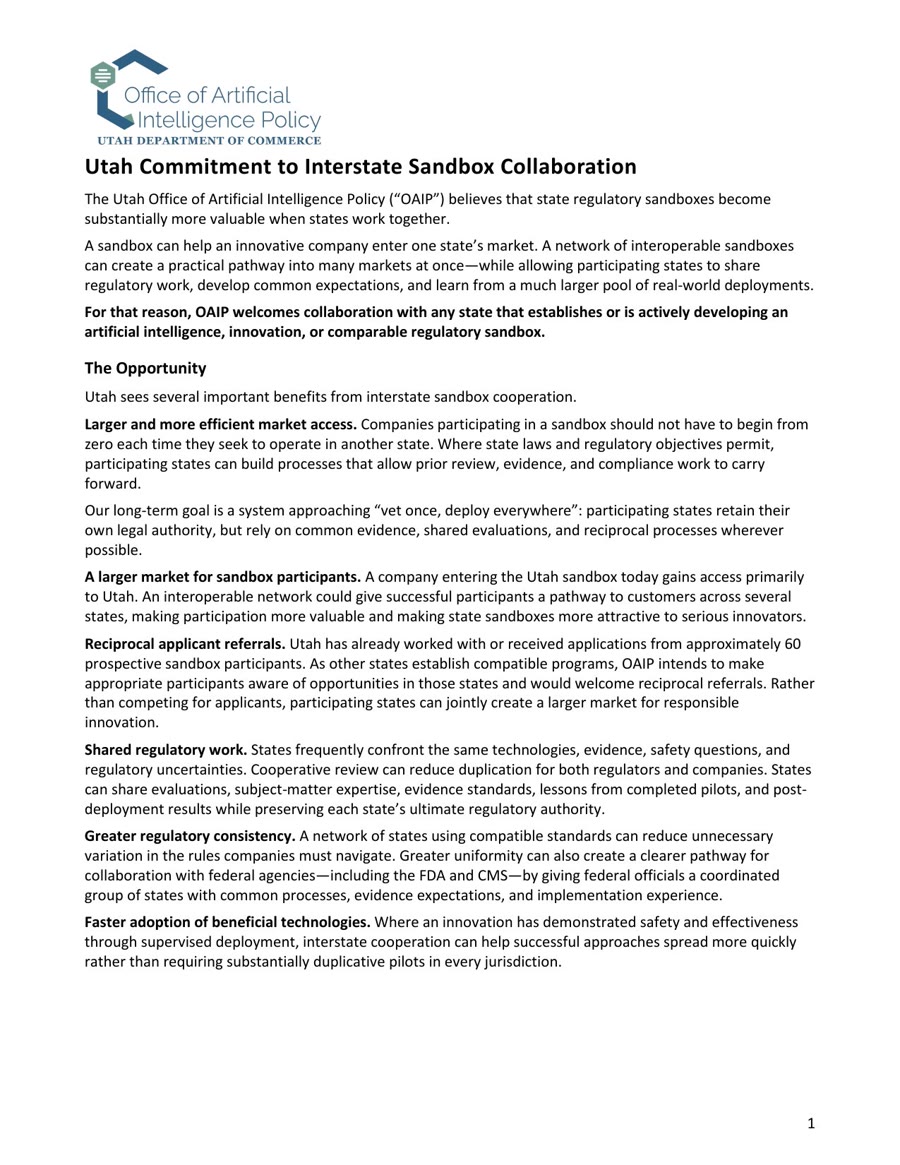
Page one of the Utah Commitment to Interstate Sandbox Collaboration Read the whole letter

The first invitation in writing

“Utah’s Office of AI Policy is prepared to begin that work now with any interested state.”
A public invitation to every state, working toward an interstate compact. September 28, 2026.
“Our aim is not to require participating states to surrender regulatory authority or adopt identical laws.”
Utah Office of Artificial Intelligence Policy

06 · Why it draws business

Innovation draws business.

Businesses, entrepreneurs and startups are drawn to states that are clearly innovative in how they review the regulations that would otherwise hold new ideas back. In Utah alone, about 60 have lined up. A compact multiplies the draw: one proven pilot becomes a path toward many markets, which can make every member state a stronger place to launch, build and hire.

  • A bigger market from one pilot

    “An interoperable network could give successful participants a pathway to customers across several states, making participation more valuable and making state sandboxes more attractive to serious innovators.”

  • Vet once, deploy everywhere

    “Our long-term goal is a system approaching ‘vet once, deploy everywhere.’” Each state keeps its own legal authority.

  • Shared referrals

    Utah has “worked with or received applications from approximately 60 prospective sandbox participants” and “intends to make appropriate participants aware of opportunities in those states.”

  • Less duplicated work

    “Cooperative review can reduce duplication for both regulators and companies.”

“Rather than competing for applicants, participating states can jointly create a larger market for responsible innovation.”
Utah Office of Artificial Intelligence Policy, public letter of September 28, 2026

07 · Federal partners

One coordinated group of states for federal partners.

When federal agencies want to work with states to pilot new programs, a compact can offer them a coordinated group of states with common processes and shared evidence, rather than one state at a time. Utah's letter says so directly.

“Greater uniformity can also create a clearer pathway for collaboration with federal agencies … by giving federal officials a coordinated group of states with common processes, evidence expectations, and implementation experience.”
Utah names the FDA and CMS. Utah's letter, page 1
“jointly engaging relevant federal agencies where a coordinated state approach could improve regulatory clarity or technology adoption.”
One of the commitments Utah lists. Utah's letter, page 2

08 · What it would take

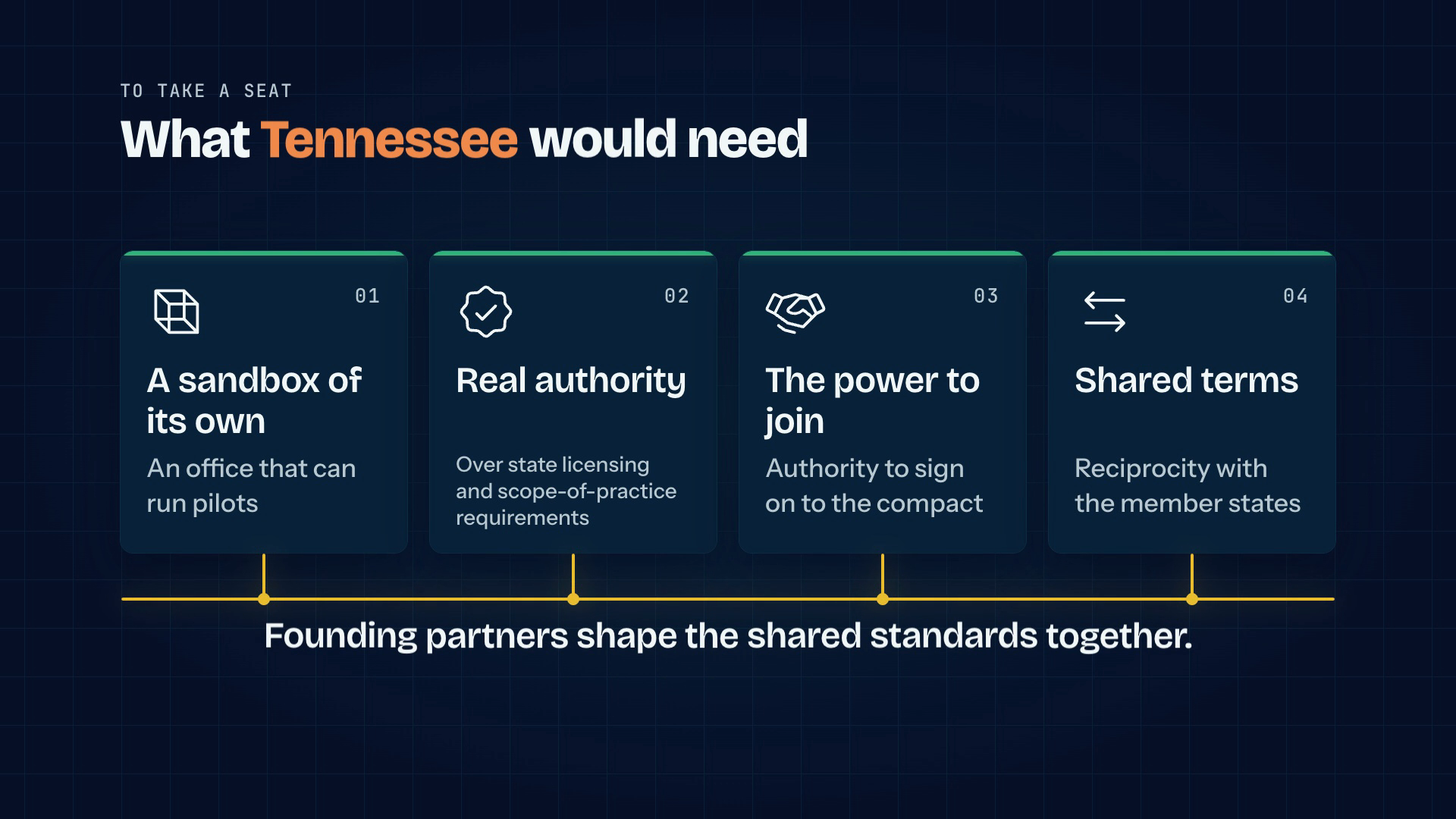
What Tennessee would need to join.

Four things put a state's sandbox in a position to take a seat in the compact.

  1. 01

    A sandbox of its own

    An office that can review applications and run pilots.

  2. 02

    Real authority

    Over state licensing and scope-of-practice requirements.

  3. 03

    The power to join

    Authority for the sandbox office or the governor to sign on to the compact.

  4. 04

    Shared terms

    Reciprocity with the member states, on conditions they set together.

Founding partners shape the shared standards together.

09 · Expert input

It still needs experts to weigh in.

This overview explains a concept; it is not a finished proposal. Whether and how it could work in Tennessee still needs the opinion of experts and industry leaders in each field it would touch, on four things.

  • Opportunities

    Where a pilot could help Tennesseans most, and which ideas are waiting on a regulation or a licensing requirement.

  • Risks

    What could go wrong, for whom, and how a pilot would catch it early.

  • Concerns

    Which protections matter most in each field, and who should be consulted first.

  • Questions

    What would have to be true for it to work here, and what is still unknown.

Licensing boards, practitioners, industry leaders, researchers, consumer advocates and the people a pilot would serve each see something the others do not.

Sources